
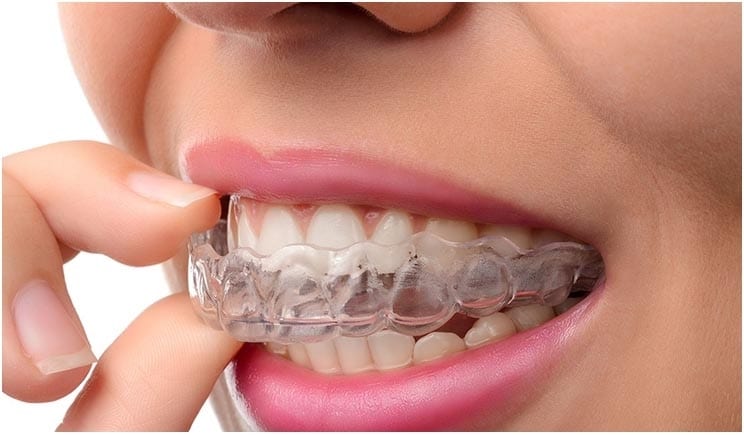
One of the questions that comes up consistently in orthodontic consultations is whether crowded teeth can be addressed without removing teeth. For patients who’ve heard that extractions are sometimes part of orthodontic treatment, this is understandably a concern. No one wants to lose healthy teeth if there’s another option.
The honest answer is that it depends on the degree of crowding and the specific anatomy involved. Clear aligners like Invisalign can treat a wide range of crowding cases without extraction, but there are situations where the space needed for tooth movement simply isn’t there, and creating it without removing a tooth isn’t realistic.
Here’s how that assessment actually works.
What Causes Crowding in the First Place
Crowding happens when there isn’t enough space in the jaw for all the teeth to sit in their correct positions. Teeth overlap, rotate, or get pushed forward or backward because the arch doesn’t accommodate them. The underlying cause is typically a mismatch between tooth size and jaw size, which can be genetic, developmental, or influenced by early tooth loss that allowed other teeth to drift and reduce available space.
The degree of crowding matters enormously. Mild crowding, where teeth are slightly overlapping or rotated, is a different clinical situation than severe crowding, where multiple teeth are significantly displaced. The treatment approach for each is different.
How Clear Aligners Create Space Without Extraction
When extraction isn’t needed, space for tooth movement usually comes from one of two sources.
Expansion: In some patients, particularly younger patients whose jaw sutures haven’t fully fused, the arch can be widened to create additional space. Clear aligners can achieve modest arch expansion as part of a treatment plan. For more significant expansion, orthodontic appliances designed specifically for that purpose may be used in conjunction with aligner treatment. Drs. Pollard, Diaz, and Kehler at Mission Creek Orthodontics assess whether expansion is appropriate and realistic based on the patient’s anatomy and age.
Interproximal reduction (IPR): This is a procedure where a small amount of enamel is removed from between specific teeth, typically a fraction of a millimetre per contact point. IPR creates space that allows teeth to move without being extracted. It’s a controlled process that the orthodontist plans precisely using the digital treatment plan. The amount of enamel removed is minimal and doesn’t affect the structural integrity or long-term health of the teeth when done within appropriate limits.
These two approaches, sometimes used together, are the primary tools for managing crowding without extraction in clear aligner treatment.
When Crowding Is Mild to Moderate
For mild to moderate crowding, clear aligners are often well-suited to treatment without any extraction. The combination of IPR and the movement mechanics of the aligner system can usually create enough space to bring the teeth into proper alignment.
At Mission Creek Orthodontics, Invisalign is used alongside digital treatment planning that maps out exactly how much space is needed, where IPR will be applied, and how teeth will move through each stage of the aligner series. The digital plan allows the team to assess whether the planned movement is realistic before treatment begins, rather than discovering limitations midway through.
Invisalign treatment in Kelowna is available for children, teens, and adults, with the treatment approach tailored to the patient’s age, anatomy, and degree of crowding.
When Extraction May Still Be Recommended
There are cases where extraction is the more appropriate path, even with clear aligners available. Severe crowding that requires more space than IPR and expansion can reasonably create is one situation. Another is when the front teeth are already positioned as far forward as they should be and moving them further forward to create space would have functional or aesthetic consequences that outweigh the benefit of avoiding extraction.
Bite correction also plays a role. In some patients with significant crowding, the bite discrepancy that comes with it, such as a deep overbite or severe protrusion, is better addressed with a plan that includes extraction. Removing a tooth strategically can allow not just space for the crowded teeth but also correction of the bite in a way that non-extraction treatment can’t fully achieve.
This is a case-by-case determination. The same degree of visible crowding in two patients might warrant different approaches depending on their jaw size, bite relationship, and treatment goals.
What the Assessment Involves
At Mission Creek Orthodontics, evaluating crowding starts with digital scans using 3D imaging technology and a full bite assessment. The team reviews tooth size, arch dimensions, bite relationship, and the degree and location of crowding before recommending an approach. This is the kind of assessment that can’t be done from a photo or a quick look in a mirror.
For patients who have been told they need extractions in the past but are looking for a second opinion, or who simply want to understand what their options are, a consultation is the practical starting point. You can also explore orthodontic treatment options for teens and adults on the clinic website, as the approach to crowding treatment varies between age groups.
Mission Creek Orthodontics | Orthodontist in Kelowna
Crowded teeth? Start with a conversation. Mission Creek Orthodontics offers free consultations for patients of all ages across Kelowna and the Central Okanagan. No referral needed; interest-free payment plans available. Book online or call 778-477-5770. The clinic is at 3975 Lakeshore Rd Unit 202, Kelowna, BC.
